


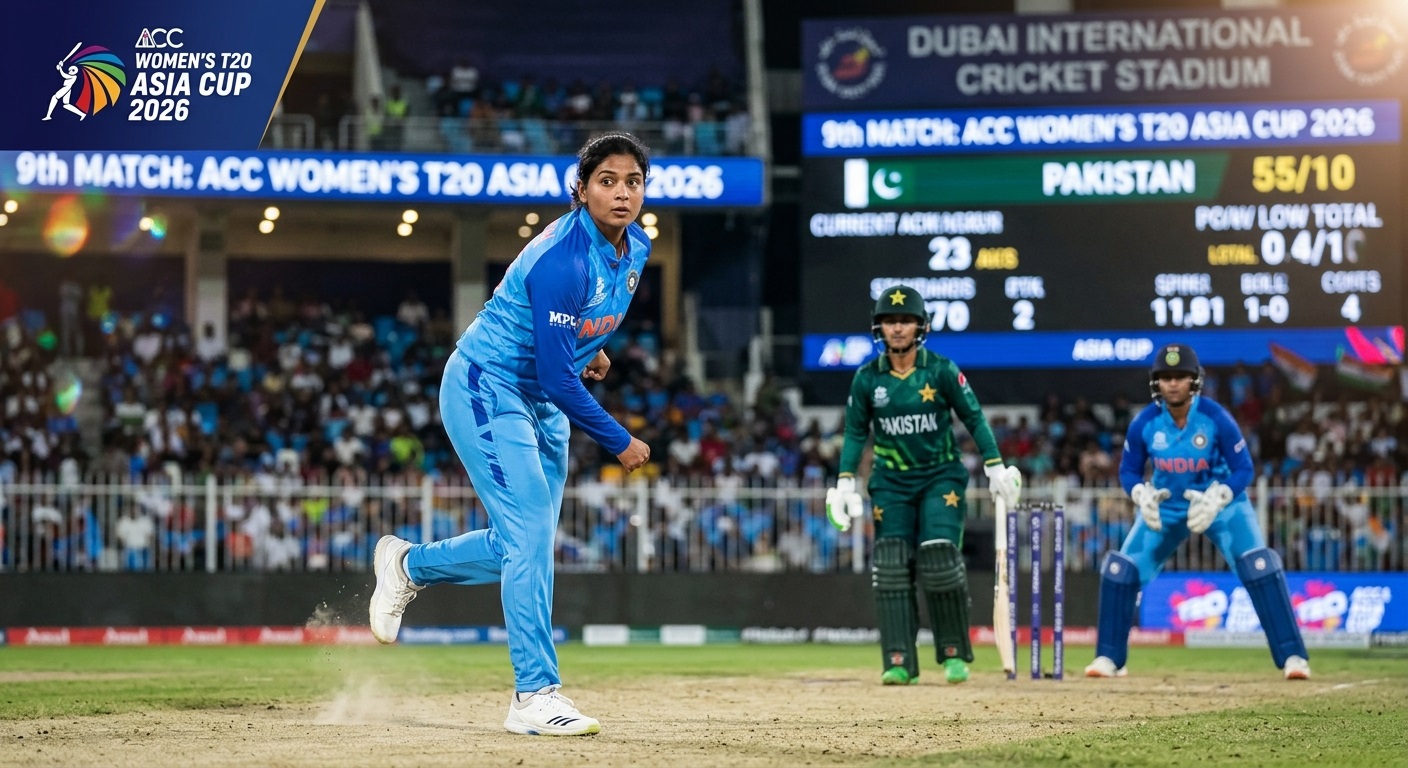
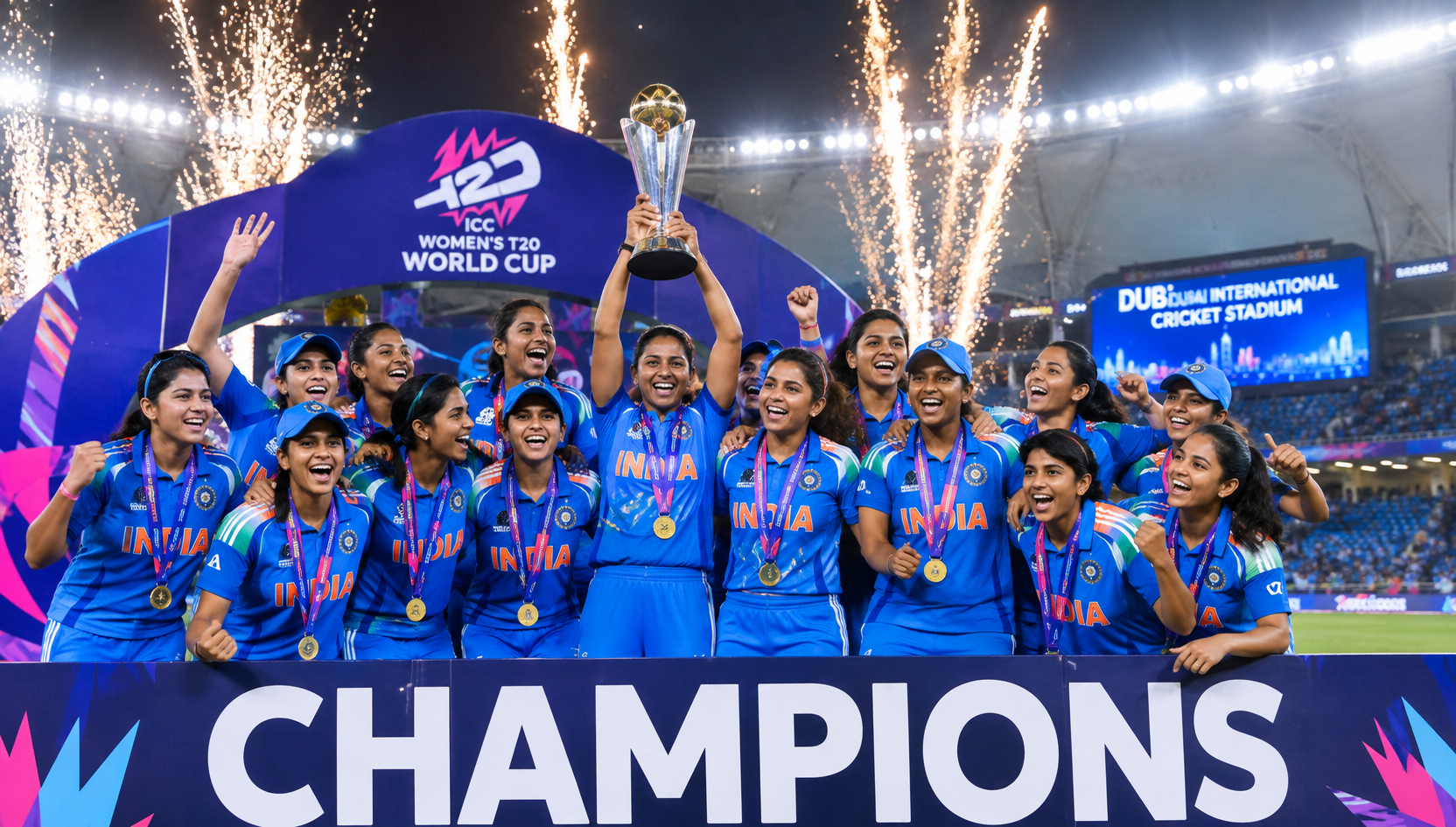
Women’s T20 Asia Cup 2026, 3 Key Factors Behind Pakistan Collapse: The blockbuster match 9 of the Women’s T20 Asia Cup 2026 delivered high-stakes drama at the Dubai International Cricket Stadium as India’s spin attack dismantled Pakistan for a modest total of 55 runs in 18.1 overs. What began as a promising opening stand quickly transformed into an unprecedented batting disaster for Pakistan, marking their lowest-ever total in Women’s T20 International history.
For cricket fans, tactical analysts, and tournament followers seeking a thorough breakdown of this historic match, this comprehensive analysis explores the bowling masterclass by Shree Charani and Prema Rawat, the anatomy of Pakistan’s mid-innings collapse, and what this result means for the Women’s T20 Asia Cup 2026 standings.
Match Summary: Key Highlights & Scoreboard Overview
Pakistan captain Fatima Sana won the toss and opted to bat first on a Dubai surface that appeared dry with subtle assistance for slow bowlers. The decision initially seemed justified during the early overs before India’s bowling unit took full control.
| Match Metric | Pakistan Women | India Women |
| Total Score | 55/10 (18.1 Overs) | Target: 56 Runs |
| Powerplay Score (1-6) | 28/3 | In Progress / Achieved |
| Top Scorer | Shawaal Zulfiqar (14 off 14) | Match Target 56 |
| Best Bowling Figures | N/A | Shree Charani (3/11), Prema Rawat (3/12) |
| Extras Conceded | 8 | N/A |
| Fall of Wickets Run Rate | 3.03 Runs Per Over | N/A |
Key Match Takeaway: Pakistan lost 9 wickets for just 28 runs after reaching 27/0 in the 5th over. India’s relentless spin choke held Pakistan to a run rate of just 3.03 per over in the Women’s T20 Asia Cup 2026.
3 Critical Factors Behind Pakistan’s Batting Collapse
1. The Opening Breakthrough: Shafali Verma Breaks the Stand
The match opened with Pakistan’s opening duo, Muneeba Ali and Shawaal Zulfiqar, showing composure against India’s pace options. They accumulated 27 runs without loss across the first four overs, finding boundaries through clever placement.
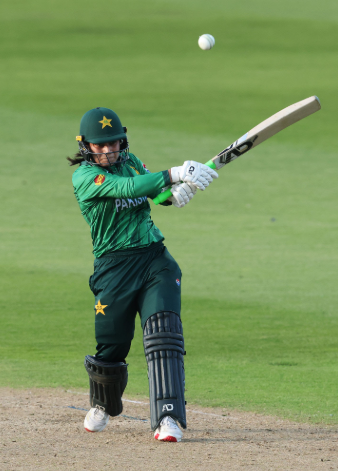
However, Indian skipper Harmanpreet Kaur turned to right-arm off-spinner Shafali Verma in the fifth over to change the tempo. After being struck for a crisp boundary by Muneeba Ali (13 off 15 balls), Verma adjusted her flight, pulled her length back slightly, and induced a mistimed shot that landed directly into the fielder’s hands.
- Turning Point: The dismissal of Muneeba broke the 27-run foundation.
- Tactical Adjustment: India immediately introduced spin from both ends to exploit the slowing surface.
- Batter Pressure: Shawaal Zulfiqar was forced into risky strokeplay, eventually falling for 14 off 14 deliveries.
2. Shree Charani’s Double-Strike Shifted Momentum
Following Verma’s breakthrough, right-arm spinner Shree Charani took charge of the match in the 6th over. Charani bowled with remarkable accuracy, varying her pace between 78 km/h and 86 km/h to test the batters’ patience.
Charani's 6th Over Sequence:
[Ball 1: 0] -> [Ball 2: Wicket (Gull Feroza 0)] -> [Ball 3: 0] -> [Ball 4: Wicket (Shawaal Zulfiqar 14)] -> [Ball 5: 0] -> [Ball 6: 0]
In a span of three deliveries, Charani removed Gull Feroza for a duck and trapped top-scorer Shawaal Zulfiqar. This double-strike reduced Pakistan from 27/0 to 27/3 within six balls, completely halting their momentum before the end of the powerplay in this Women’s T20 Asia Cup 2026 fixture.
3. Prema Rawat and Deepti Sharma Scour the Middle Order
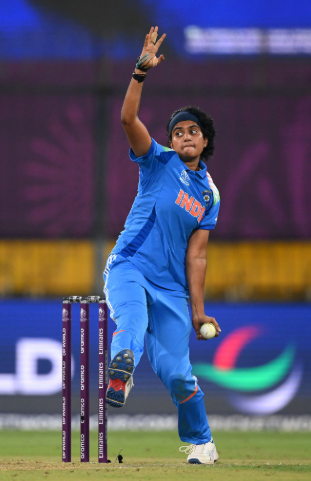
With Pakistan reeling at 27/3, India’s slow bowling tandem of Prema Rawat and Deepti Sharma maintained relentless pressure through tight line and length. Pakistan’s middle-order batters struggled against the turning ball, unable to find gaps or rotate strike effectively.
- Fatima Sana (0 off 4): The skipper attempted a lofted drive off Rawat but misjudged the drift, offering an easy catch.
- Ayesha Zafar & Sadaf Shamas: Both middle-order line-ups fell in quick succession while trying to force strokes against Deepti Sharma’s arm balls.
- Tuba Hassan’s Resistance: Lower-order batter Tuba Hassan showed defensive grit, but lacked support at the other end as Pakistan folded for 55 in 18.1 overs.
Comprehensive Fall of Wickets Breakdown
To understand how rapidly the innings unravelled in this Women’s T20 Asia Cup 2026 contest, the chronological fall of wickets highlights India’s complete control:
- 1st Wicket (27/1): Muneeba Ali c Ghosh b Verma (4.2 overs)
- 2nd Wicket (27/2): Gull Feroza c Kaur b Charani (5.2 overs)
- 3rd Wicket (27/3): Shawaal Zulfiqar b Charani (5.4 overs)
- 4th Wicket (31/4): Ayesha Zafar lbw b Rawat (7.1 overs)
- 5th Wicket (34/5): Fatima Sana c Sub b Rawat (8.5 overs)
- 6th Wicket (39/6): Sadaf Shamas b Deepti Sharma (11.2 overs)
- 7th Wicket (42/7): Eyman Fatima c Ghosh b Charani (13.1 overs)
- 8th Wicket (48/8): Nashra Sandhu run out (15.4 overs)
- 9th Wicket (52/9): Sadia Iqbal b Deepti Sharma (17.2 overs)
- 10th Wicket (55/10): Umm-e-Hani b Rawat (18.1 overs)
Detailed Bowling Performance Metrics
India’s bowling performance in match 9 of the Women’s T20 Asia Cup 2026 demonstrated exceptional consistency across all four bowling options.
| Bowler Name | Overs Bowled | Maidens | Runs Conceded | Wickets Taken | Economy Rate | Dot Balls Bowled |
| Shree Charani | 4.0 | 1 | 11 | 3 | 2.75 | 18 |
| Prema Rawat | 3.1 | 0 | 12 | 3 | 3.78 | 14 |
| Deepti Sharma | 4.0 | 1 | 14 | 2 | 3.50 | 16 |
| Shafali Verma | 3.0 | 0 | 10 | 1 | 3.33 | 11 |
| Kranti Gaud | 2.0 | 0 | 5 | 0 | 2.50 | 9 |
| Nandani Sharma | 2.0 | 0 | 3 | 0 | 1.50 | 9 |
Statistical Insight: India’s spinners combined for 8 wickets while conceding just 47 runs in 14.1 overs, maintaining a joint economy rate of 3.32 throughout the Women’s T20 Asia Cup 2026 match.
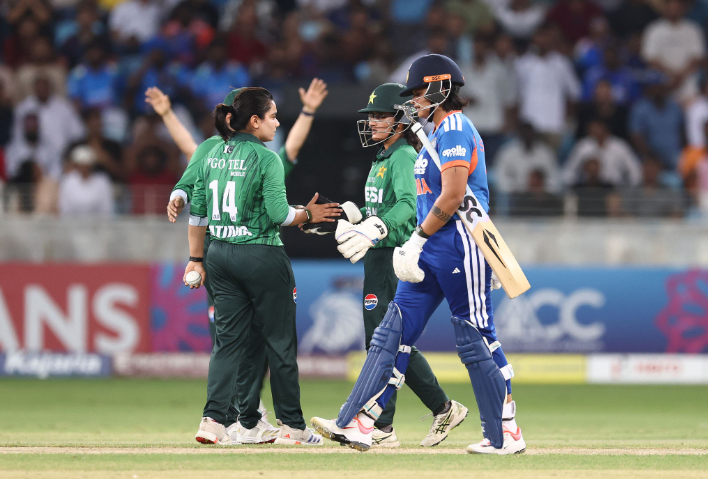
Tournament Standings & Net Run Rate (NRR) Impact
This result creates significant ripples across the tournament table for the Women’s T20 Asia Cup 2026.
- India’s NRR Boost: Restricting Pakistan to 55 allows India to massively increase their Net Run Rate, positioning them favorably for top-seed qualification in the knockout stages.
- Pakistan’s Qualification Equation: Suffering a heavy defeat drops Pakistan’s NRR significantly. They must win their remaining group matches against lower-ranked opposition by substantial margins to maintain semi-final hopes.
- Spin Dominance in Dubai: The conditions at the Dubai International Cricket Stadium proved that teams relying heavily on spin bowling will hold a distinct tactical advantage as the Women’s T20 Asia Cup 2026 progresses.
Frequently Asked Questions
What was Pakistan’s total score against India in the Women’s T20 Asia Cup 2026 match?
Pakistan was bowled out for 55 runs in 18.1 overs against India in match 9 of the Women’s T20 Asia Cup 2026 at Dubai. This score represents Pakistan’s lowest-ever team total in Women’s T20 International cricket history.
Who were the top bowlers for India against Pakistan?
Shree Charani and Prema Rawat led India’s bowling attack, taking 3 wickets for 11 runs and 3 wickets for 12 runs, respectively. All-rounder Deepti Sharma supported them with 2 wickets for 14 runs, while Shafali Verma picked up 1 wicket.
Who scored the most runs for Pakistan in this match?
Opening batter Shawaal Zulfiqar was Pakistan’s highest scorer, making 14 runs off 14 deliveries, including three boundaries. Fellow opener Muneeba Ali was the only other batter to reach double figures, scoring 13 runs off 15 balls.
Where was the India vs Pakistan Women’s T20 Asia Cup 2026 match played?
The match took place at the Dubai International Cricket Stadium in Dubai, UAE, on Saturday, September 5, 2026. The pitch offered considerable assistance to slow bowlers in the second half of the first innings.
How did the collapse unfold during the Pakistan innings?
Pakistan lost 9 wickets for just 28 runs after an opening partnership of 27 between Muneeba Ali and Shawaal Zulfiqar. The collapse began in the 5th over with Shafali Verma’s breakthrough, followed by Shree Charani’s double-strike in the 6th over.
What are the main tournament implications of this result?
India gained a substantial boost to their Net Run Rate (NRR) in the group standings of the Women’s T20 Asia Cup 2026. Pakistan must win their remaining fixtures convincingly to stay in contention for a semi-final spot.
Strategic Takeaways and Tournament Outlook
The ninth match of the Women’s T20 Asia Cup 2026 highlighted India’s deep spin bowling options and tactical discipline. By adjusting lines and lengths after the powerplay, India transformed an encouraging start from Pakistan into a decisive batting collapse.
- Spin Supremacy: India’s slow bowlers proved adapt at using the Dubai surface, restricting run scoring while taking consistent wickets.
- Top-Order Vulnerability: Pakistan’s batting lineup faces clear challenges in middle-overs shot selection under tight field settings.
- Tournament Trajectory: As the Women’s T20 Asia Cup 2026 moves toward the semi-finals, bowling depth and adaptability to sub-continent conditions remain key indicators of success.
For continued ball-by-ball analysis, updated player statistics, and live standings throughout the tournament, stay tuned to our coverage of the Women’s T20 Asia Cup 2026.
Read more sports news and latest updates
Read more cricket news and latest updates







Leave a Reply