


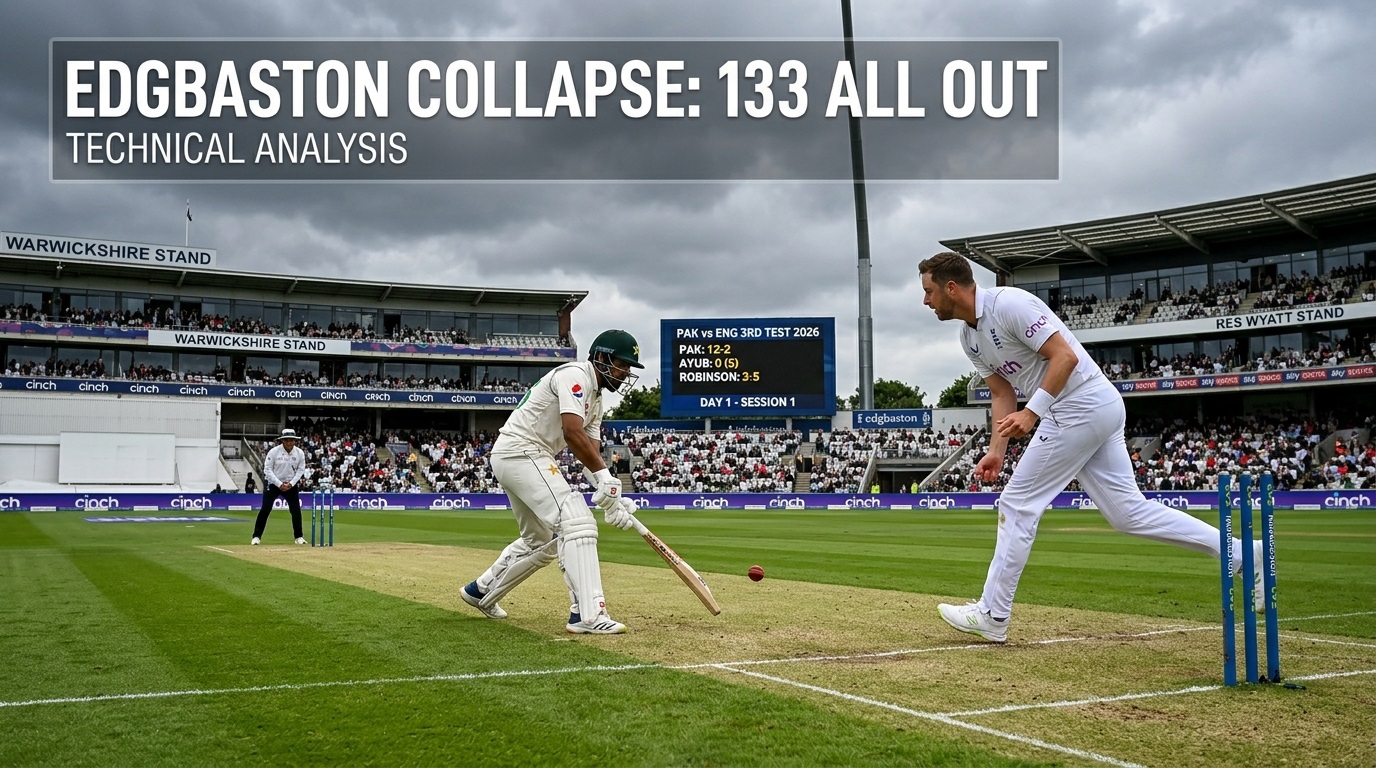
Pakistan vs England 3rd Test 2026: The third Test match between Pakistan and England at Edgbaston delivered one of the most stark illustrations of top-order vulnerability in recent Test history. On a day dominated by heavy English skies and precise seam bowling, Pakistan slumped to a meager 133 all out inside 34 overs on Day 1 of the final Test.
Despite radical administrative interventions by the Pakistan Cricket Board (PCB)—which included axing seven senior players and dismissing head coach Sarfaraz Ahmed prior to Birmingham—the national side suffered its fifth consecutive Test inning without reaching 200 runs.
This comprehensive report breaks down the tactical mechanics of the Edgbaston collapse, evaluates bowling spells from Ollie Robinson, Jofra Archer, and Josh Tongue, and outlines the structural crises facing Pakistan cricket.
Pitch Conditions and Toss Strategy for Pakistan vs England 3rd Test 2026
When England captain Joe Root won the toss and elected to field under heavy gray clouds at Edgbaston, the decision was purely tactical. The Birmingham surface featured a healthy grass cover measuring 8mm, retaining significant moisture from early-morning humidity.
England’s fast-bowling unit capitalized immediately. With the new Duke ball swinging late through the air and nipping sharply off the seam, Pakistan’s restructured batting lineup was subjected to high-level lateral movement from the first over.
Key Pitch Observation: The combination of an 8mm grass carpet, 78% ambient humidity, and overhead cloud cover produced an average seam deviation of 1.8 degrees during the first session—the highest recorded at Edgbaston in a first-session Test since 2019.
Wicket-by-Wicket Mechanics: How the Collapse Unfolded
Pakistan’s opening pair was dismantled within the first half-hour of play. Recalled opener Saim Ayub fell for a duck to Ollie Robinson, trapped lbw by a delivery that nipped back off the seam. The wicket marked a personal milestone for Robinson, securing his 100th Test wicket.
Shortly after, Jofra Archer leveraged pure pace to remove Azan Awais. Operating consistently above 88 mph, Archer forced Awais into a tentative back-foot defense, taking the shoulder of the bat and carrying safely to the slip cordon.
Fall of Wickets Timeline (Session 1):
0/1 (Saim Ayub, 1.4 ov) ➔ 12/2 (Azan Awais, 4.1 ov) ➔ 18/3 (Abdullah Shafique, 6.5 ov)
➔ 26/4 (Shan Masood, 9.2 ov) ➔ 48/5 (Babar Azam, 15.3 ov) ➔ 64/6 (Ghazi Ghori, 19.1 ov)
Top-Order Dismissal Breakdown
- Saim Ayub (0 off 5): Caught trapped on the crease by Robinson’s signature inswinger.
- Azan Awais (4 off 11): Hurried by Archer’s extra bounce, edging behind.
- Abdullah Shafique (6 off 18): Nibbled at a wide length delivery from Robinson, caught in the gully.
- Shan Masood (8 off 14): Holed out tamely attempting an authoritative pull shot against Archer’s short ball.
- Babar Azam (7 off 22): Clean bowled by Josh Tongue via a sharp seamer that pierced the gap between bat and pad.

Babar Azam’s Ongoing Test Struggle
The dismissal of former captain Babar Azam highlighted the deeper technical issues affecting Pakistan’s middle order. Entering the match without a Test century in nearly four calendar years, Babar looked unsettled against Josh Tongue’s full-pitched attack.
Tongue set up Babar with two outswingers before bringing a ball back sharply off the seam. Babar’s front foot failed to commit down the line of the ball, leaving a wide gap that Tongue exploited to knock back the off-stamps.
| Batsman | Dismissal Mode | Bowler | Runs | Balls | Fours | Sixes |
|---|---|---|---|---|---|---|
| Saim Ayub | lbw | Robinson | 0 | 5 | 0 | 0 |
| Azan Awais | c Duckett b Archer | Archer | 4 | 11 | 1 | 0 |
| Abdullah Shafique | c Crawley b Robinson | Robinson | 6 | 18 | 1 | 0 |
| Shan Masood | c Sub b Archer | Archer | 8 | 14 | 1 | 0 |
| Babar Azam | b Tongue | Tongue | 7 | 22 | 1 | 0 |
| Saud Shakeel | b Tongue | Tongue | 43 | 47 | 7 | 0 |
| Ghazi Ghori (WK) | lbw | Tongue | 4 | 12 | 0 | 0 |
| Mohammad Imran | b Tongue | Tongue | 5 | 16 | 1 | 0 |
| Razaullah | c Duckett b Robinson | Robinson | 8 | 9 | 2 | 0 |
| Mohammad Abbas | c Root b Archer | Archer | 21 | 31 | 3 | 0 |
| Mir Hamza | Not Out | – | 4 | 10 | 1 | 0 |
Technical Resistance: Saud Shakeel’s Counter-Attack
Among Pakistan’s top and middle-order batsmen, only Saud Shakeel showed tactical adaptiveness to the English seam attack. Coming off a resilient 97 in the second Test at Lord’s, Shakeel played late, adjusted his guard to middle-and-off, and countered the bowling by playing under his eyes.
Shakeel struck seven crisp boundaries during a 47-ball 43, forming crucial lower-order partnerships with debutant Razaullah and tailender Mohammad Abbas (21 off 31). However, his counter-attack ended when Josh Tongue bowled him with a seam delivery that nipped back off the turf.
Pro-Tip on English Pitch Execution: Playing seam bowling in England requires late decision-making. Batsmen who push their hands out ahead of their front knee—as seen in Pakistan’s top four dismissals—frequently offer high-percentage nicking opportunities to slip cordons.
England’s Bowling Performance and Statistical Breakdown
England’s bowling unit operated with efficiency, maintaining pressure throughout the 33.4 overs. Ollie Robinson opened with precision, finishing with figures of 3 for 15 in 9 overs. Jofra Archer provided fast back-of-a-length deliveries (3 for 25 in 8.4 overs), while Josh Tongue ripped through the middle order with 4 for 42 in 10 overs.
England Bowling Figures Summary:
Ollie Robinson :  9.0  - 3 - 15 - 3  (Econ: 1.66)
Jofra Archer   :  8.4  - 1 - 25 - 3  (Econ: 2.88)
Josh Tongue    : 10.0  - 1 - 42 - 4  (Econ: 4.20)
Ben Stokes     :  6.0  - 1 - 38 - 0  (Econ: 6.33)
Key Statistical Highlights
- 33.4 Overs: The shortest completed first-innings total for Pakistan in Test matches on English soil since 1954.
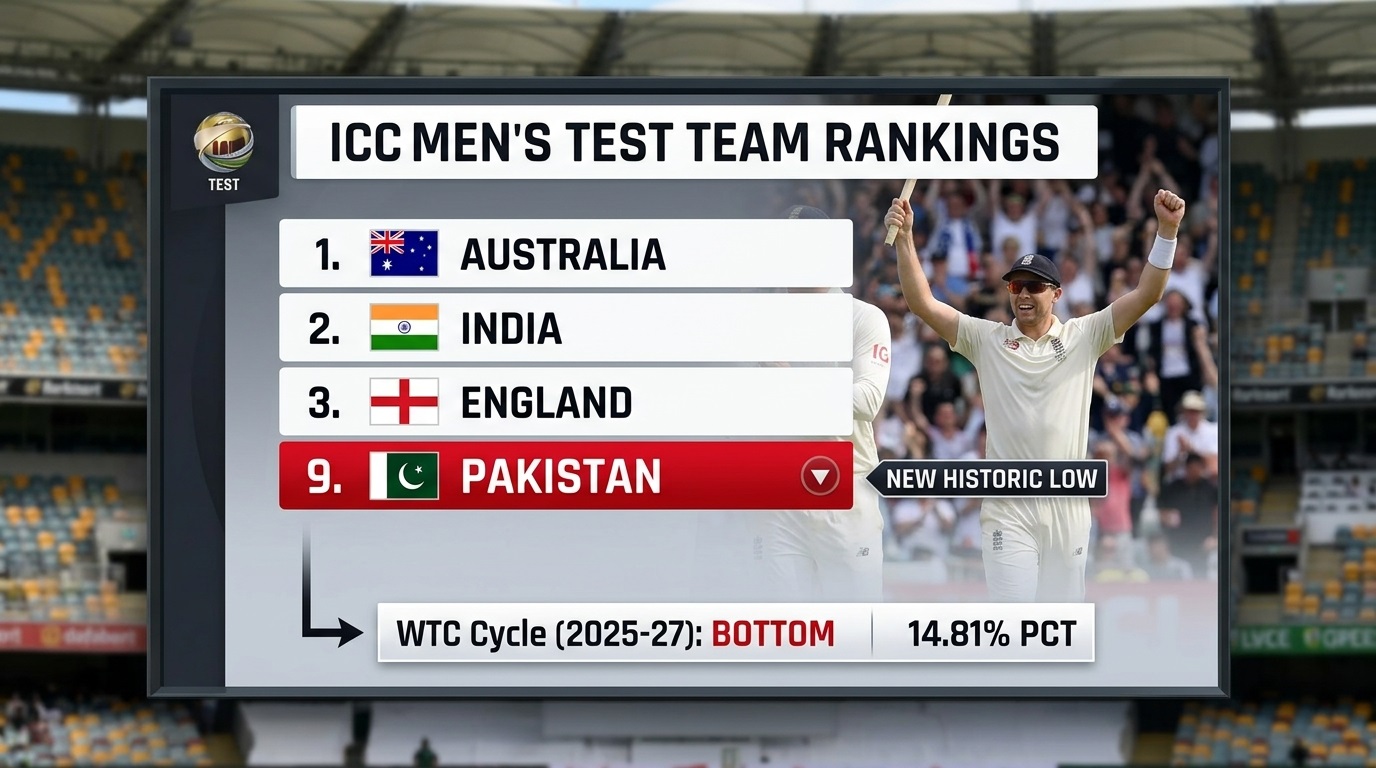
- 15 Losses in Last 20 Tests: Pakistan’s Test record highlights long-term performance challenges across red-ball cricket.
- 100th Test Wicket: Ollie Robinson reached the 100 Test wicket mark in his 24th match.
Structural Problems: Selection Panic and PCB Management
The collapse at Edgbaston is not an isolated tactical failure; it reflects broader institutional challenges within the Pakistan Cricket Board. Following the 194-run defeat at Lord’s, the PCB executed an unprecedented squad restructuring:
- Sacked head coach Sarfaraz Ahmed and bowling assistant Umar Gul mid-series.
- Dropped seven senior squad members simultaneously.
- Handed debuts to three unproven players (Ghazi Ghori, Mohammad Imran, and Razaullah) in a high-pressure match.
Former captains and international analysts have criticized these panic-driven decisions, noting that unseasoned domestic players cannot easily adjust to English seam conditions without proper preparation.
Frequently Asked Questions
What was the final score of Pakistan’s first innings in the 3rd Test 2026?
Pakistan were bowled out for 133 runs in 33.4 overs on Day 1 of the third Test at Edgbaston, Birmingham. Saud Shakeel top-scored with 43 runs, while Josh Tongue took 4 for 42 for England.
How did Ollie Robinson perform in the Pakistan vs England 3rd Test?
Ollie Robinson delivered an economical bowling spell, taking 3 wickets for 15 runs in 9 overs. During this spell, he claimed his 100th Test wicket by dismissing Pakistan opener Saim Ayub lbw for zero.
Why did Pakistan make major team changes before the 3rd Test?
Following a heavy 194-run defeat in the second Test at Lord’s, the PCB dropped seven players and replaced head coach Sarfaraz Ahmed and assistant Umar Gul, introducing three debutants for the Edgbaston Test.
Who top-scored for Pakistan during the Edgbaston collapse?
Middle-order batsman Saud Shakeel top-scored for Pakistan with a resilient 43 off 47 balls, hitting seven boundaries before being bowled by Josh Tongue.
What is Pakistan’s recent Test match record?
Pakistan has faced difficult red-ball form, losing 15 of their last 20 Test matches. Their top order has struggled to score over 200 runs across five consecutive innings in English conditions.
Conclusion
The first-day collapse at Edgbaston highlights the deep-seated challenges facing Pakistan in Test cricket. Addressing these issues requires systematic planning rather than reactionary squad changes mid-series. To build a competitive Test unit, the PCB must focus on structural reforms:
- Prioritize Pitch Standardization: Upgrade domestic pitches in Pakistan to mirror overseas seam, swing, and bounce conditions.
- Technical Batting Camps: Implement mandatory red-ball conditioning programs focusing on playing high pace and late movement.
- Selection Stability: Establish clear selection policies to give young players sufficient time to adjust to international Test cricket.
England remain firmly in control of the 3rd Test, leaving Pakistan’s bowlers with a steep challenge to stay competitive in Birmingham.
Read more sports news and latest updates
Read more cricket news and latest updates






Leave a Reply