


Junior Asia Cup 2026 bronze match: Trailing by two goals within thirteen minutes of an international medal fixture usually signals systemic breakdown. When Malaysia struck twice in rapid succession during the opening quarter at the Moqi Training Base in Hulunbuir, China, Pakistan’s campaign at the 2026 Men’s Junior Asia Cup appeared destined for a disappointing fourth-place finish.
Instead, what unfolded across the final three quarters was a masterclass in tactical adaptability and psychological resilience. Pakistan orchestrated a breathtaking four-goal unanswered comeback to seal a 4-2 victory over Malaysia, securing the bronze medal and reaffirming the potent talent existing within their national youth pipeline.
This analysis evaluates the key tactical shifts, match statistics, individual individual performances, and structural context behind Pakistan’s victory in the Junior Asia Cup 2026 bronze match.
Match Summary & Tactical Breakdown
| Match Phase | Key Event / Highlight | Tactical Context |
| Q1 (0-15 min) | Adam Ashraf Johari (11′ FG) Shafiq Ammar Fahmi Suzaini (13′ PC) | Malaysia exploited defensive over-commitment in Pakistan’s circle. |
| Q2 (16-30 min) | Tactical adjustments by Pakistan | Pakistan established midfield control and reduced turnovers. |
| Q3 (31-45 min) | Rana Abdul Sami (34′ FG) | High-press pressure forced a Malaysian turnover inside the 25-yard line. |
| Q4 (46-60 min) | Rana Abdul Sami (47′ FG) Muhammad Shaheer (52′ PC) Waleed Rana (56′ PS) | Exploited Malaysian fatigue with set-piece precision and relentless circle entries. |

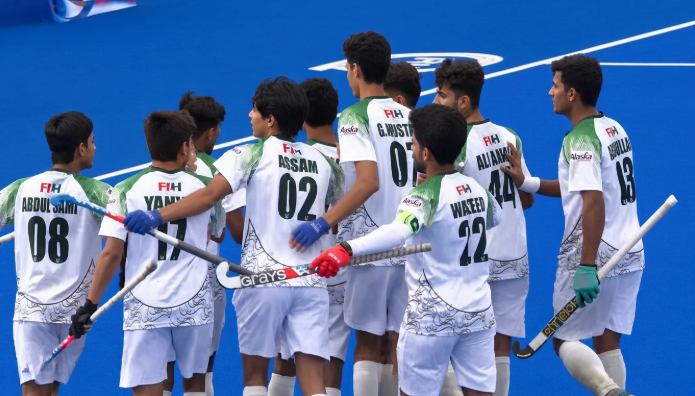
The First Quarter: Defensive Lapses and Early Disasters
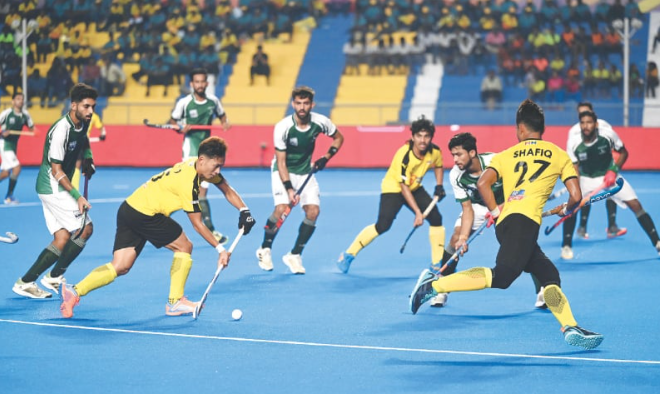
Malaysia began the bronze-medal match with relentless intensity, exploiting early structural disconnects between Pakistan’s midfield and defensive line. In the 11th minute, Adam Ashraf Johari capitalised on a loose ball following a rapid counter-attack down the right flank, driving a sharp field goal past the Pakistani goalkeeper.
Before Pakistan could recalibrate their defensive structure, Malaysia struck again. A foul inside the scoring circle granted Malaysia a penalty corner in the 13th minute. Shafiq Ammar Fahmi Suzaini converted with precision, firing a drag-flick into the top left corner to give Malaysia an early 2-0 lead.
Key Match Insight: During the opening 15 minutes, Pakistan conceded 4 penalty corners and committed 7 turnover errors in their own defensive third, creating an immediate two-goal deficit.
The Turnaround: Midfield Control and Tactical Adjustments
Following the initial setback, Pakistan shifted from a passive mid-block to an aggressive high-court press. By pushing their wing-backs higher up the pitch, Pakistan choked Malaysia’s outlet passes and forced critical turnovers near the 25-yard line.
The tactical shift bore fruit shortly after half-time:
- The Equaliser Drive (34th Minute): Rana Abdul Sami pounced on a misdirected clearance from the Malaysian defense, weaving past two defenders before slotting home a clinical field goal to make it 2-1.
- Restoring Parity (47th Minute): Early in the fourth quarter, Sami struck again with another field goal, finishing a swift passing combination to tie the match at 2-2.
- Taking the Lead (52nd Minute): Capitalising on mounting momentum, Pakistan earned a critical penalty corner. Specialist Muhammad Shaheer executed a powerful drag-flick to complete the comeback at 3-2.
- Sealing the Bronze (56th Minute): With Malaysia forced to commit extra players forward, Pakistan won a penalty stroke after a deliberate goal-line foul. Waleed Rana calmly converted from the spot to lock in the final 4-2 scoreline.
Individual Standout Performances
While the victory required collective determination, three individual players played decisive roles in swinging the match momentum in Pakistan’s favor.
Individual Impact Ratings (Bronze Medal Match)
------------------------------------------------------
Rana Abdul Sami   [★★★★★] 2 Goals, High-Press Catalyst
Muhammad Shaheer  [★★★★☆] Go-Ahead Goal, 85% Tackle Rate
Waleed Rana       [★★★★☆] Clutch Penalty Stroke, Midfield Anchor
------------------------------------------------------
1. Rana Abdul Sami: Player of the Match
Sami’s off-ball positioning transformed Pakistan’s attacking output in the second half. His movement created space inside the circle, allowing him to score two field goals under pressure.
2. Muhammad Shaheer: The Set-Piece Anchor
Shaheer stabilized Pakistan’s transition play. His conversion from the 52nd-minute penalty corner marked the tipping point of the match, shifting pressure firmly onto Malaysia.
3. Waleed Rana: Midfield Composure
In addition to converting the match-ending 56th-minute penalty stroke, Waleed broke up multiple Malaysian counter-attacks during the tense third quarter, regaining possession 12 times in central areas.
Pakistan’s Full Campaign Overview: Men’s Junior Asia Cup 2026
To fully evaluate Pakistan’s performance in the Junior Asia Cup 2026 bronze match, one must examine their broader campaign trajectory at the Moqi Training Base in Hulunbuir.

Pakistan was placed in Group B alongside Kazakhstan, China, Malaysia, and Bangladesh. They produced a dominant group stage campaign before experiencing a tough semi-final setback against South Korea.
Group Stage Dominance
- Pakistan 15 – 0 Kazakhstan: A dominant opening match featuring 9 distinct goal-scorers.
- Pakistan 4 – 2 China: A hard-fought win against the host nation, showcasing strong transition defense.
- Pakistan 5 – 2 Malaysia: A precursor to the bronze match, where Pakistan’s physical play wore down the Malaysian defense.
- Pakistan 3 – 0 Bangladesh: A clean sheet victory that secured top spot in Group B with a perfect 12 points.
Semi-Final Setback vs. South Korea
- Pakistan 1 – 4 South Korea: In the semi-finals, South Korea disrupted Pakistan’s tempo with high tactical discipline, exploiting set-piece opportunities to end Pakistan’s championship hopes.
Performance Summary: Across 6 tournament matches, Pakistan scored 29 goals and conceded 10, demonstrating elite offensive firepower while identifying defensive areas requiring refine before global competition.
Tactical Analysis: Why Pakistan Beat Malaysia Twice
Facing the same opponent twice in a single tournament presents distinct tactical challenges. Pakistan beat Malaysia 5-2 in the group stage and 4-2 in the bronze medal match.

Key tactical advantages that propelled Pakistan over Malaysia included:
- Physical and Aerial Superiority: Pakistan consistently won aerial duels and physical contests in the central third, bypassing Malaysia’s mid-court trap.
- Penalty Corner Execution: Across both encounters, Pakistan converted over 35% of set-piece opportunities, forcing Malaysia to play defensively inside their circle.
- Conditioning and Fourth-Quarter Stamina: In both matches, Malaysia scored early but struggled to match Pakistan’s pace and pressure in the final 15 minutes.
Frequently Asked Questions
What was the final score of the Junior Asia Cup 2026 bronze match?
Pakistan defeated Malaysia 4-2 in the bronze medal match at the 2026 Men’s Junior Asia Cup. After trailing 2-0 early, Pakistan scored four unanswered goals to secure the medal at the Moqi Training Base in Hulunbuir, China.
Who scored the goals for Pakistan against Malaysia?
Rana Abdul Sami scored two field goals in the 34th and 47th minutes to equalize. Muhammad Shaheer scored the go-ahead goal via a penalty corner in the 52nd minute, while Waleed Rana sealed the victory with a 56th-minute penalty stroke.
Who scored for Malaysia in the bronze medal match?
Malaysia scored both of their goals in the first quarter. Adam Ashraf Johari opened the scoring with an 11th-minute field goal, and Shafiq Ammar Fahmi Suzaini doubled the lead with a 13th-minute penalty corner conversion.
Where was the Men’s Junior Asia Cup 2026 hosted?
The tournament was hosted at the Moqi Training Base in Hulunbuir, Inner Mongolia, China. The venue hosted all group stage matches, knockout rounds, and medal fixtures.
How did Pakistan perform in the group stage of the tournament?
Pakistan topped Group B with a perfect 12 points from four matches. They recorded wins against Kazakhstan (15-0), China (4-2), Malaysia (5-2), and Bangladesh (3-0) before losing 4-1 to South Korea in the semi-finals.
Pakistan’s 4-2 victory over Malaysia in the Junior Asia Cup 2026 bronze match stands as a testament to the squad’s character, technical potential, and resilience under pressure. Overcoming a two-goal deficit against a well-drilled opponent requires elite tactical versatility—qualities this young side demonstrated convincingly in Hulunbuir.
Moving forward, the Pakistan Hockey Federation must build upon this foundation. By addressing early-game defensive vulnerabilities and enhancing set-piece defense, this young squad can translate regional podium finishes into sustained success on the world stage.